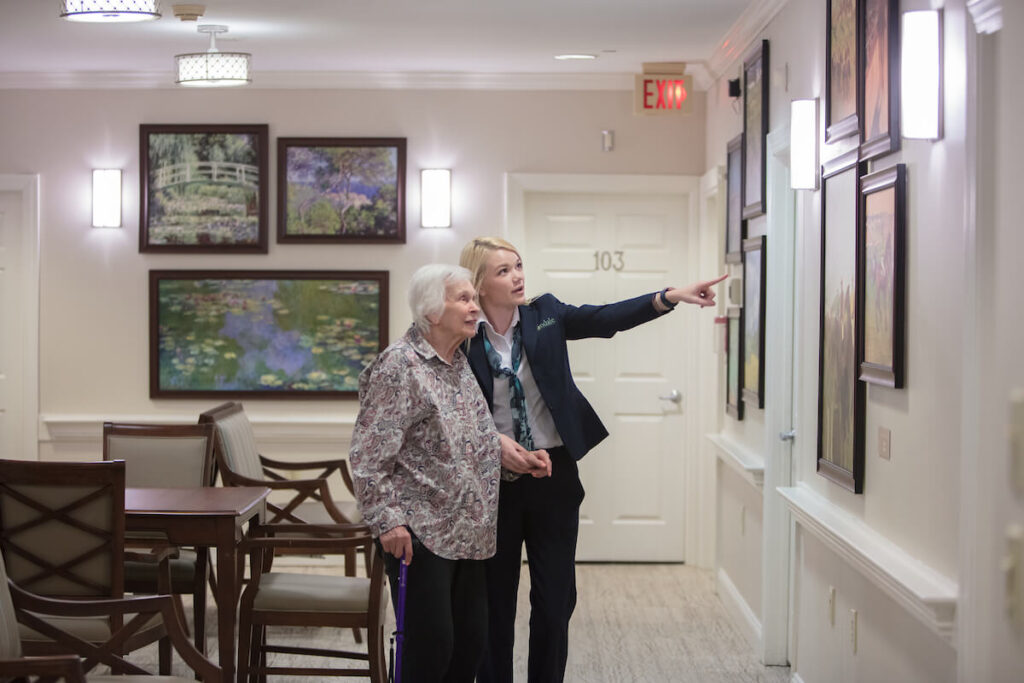
1. The Grove Memory Impaired Program at The Towers

    March 27, 2013 by RUI

    The Grove offers a state of the art clinical program for dementia management that utilizes the Allen Cognitive Battery, a proven framework for identifying the dementia resident’s highest level of function in all activities. The Grove team works in partnership with our in-house rehab team – Legacy Healthcare and Neuro-psychiatrist, Dr. Salmaan Khawaja to identify the type of dementia and then uses that information to develop an Individual Care Plan that encompasses everything from recreational and social and functional activities to Speech, Physical and Occupational Therapy.

    The Allen Cognitive Battery, developed by Claudia Allen, measures overall reasoning and mental abilities through observation and assessment of performance with familiar as well as unfamiliar tasks to identify the resident’s BATF (Best Ability to Function). By determining the resident’s Allen Cognitive Level, our staff and therapists are able to provide superior treatment and education that can maximize the current level of intellectual function using therapeutic activities and interventions that are most appealing to the resident’s personal interests. We work to educate family and staff to provide activities that do not exceed the resident’s specific cognitive level (which could increase frustration and agitation) or fail to provide the stimulation the resident needs (which could lead to boredom, isolation, and possible depression). Our therapy is not a one-size-fits-all type of treatment. At The Grove we are committed to ensuring that each resident has access to services aimed at maintaining his/her highest level of function and independence.

    Additionally, The Grove offers a brand new, state of the art, secure environment that has been specifically designed and built for residents with dementia. Beautiful walking paths in the Grove’s own outdoor gardens coupled with eye appealing dining areas and restful casual areas make it the perfect environment for safety, comfort and peace of mind.

    For more information on The Grove, or any of the Tower’s programs and services, you may call (804) 320-1412 or visit our website at www.TheTowers.net.


  2. Moving Elderly Parents: Convincing Mom and Dad

    February 7, 2013 by RUI

    Read one family’s personal account of dealing with making the move into assisted living…

    In 2001, Gail Heimberg says she had to make one of the most difficult decisions of her life. Her 88-year-old mother–a sharp, independent woman who had lived alone in Brooklyn, New York, for most of the latter part of her life–was quickly growing frail. While she used to walk from her home to the neighborhood bakery with ease, navigating the stairs of her circa-1920 apartment building had become a daily battle. “She couldn’t walk very well,” remembers Heimberg. “And her emphysema had worsened.”

    Heimberg knew the discussion she needed to have with her mother, yet like many adult children who were thinking of moving elderly parents, the three words ” assisted living facility” seemed foreign, cold and impossible to utter.

    Time is of the Essence – Having That Tough Conversation

    A few months passed, and Heimberg got a disturbing call. Her mother had suffered a mild heart attack and had been taken to the hospital. Heimberg used the opportunity to share her concerns with her mother. But when the subject came to moving her mother away from her home, she was met with sharp resistance. “No,” said her mother firmly. “I’m not moving.”

    Those can be the most difficult words a concerned child may hear their elderly parent say. So how does a worried family member convince a recalcitrant parent that moving to a long-term care facility is in their best interest?

    Tips From The Experts

    When it comes to moving elderly parents and broaching the “nursing home” or “assisted living” conversation, experts like Stella Henry, R.N., author of The Eldercare Handbook(HarperCollins, 2006) say “this is probably one of the hardest decisions a child will ever have to make.” Henry, an eldercare specialist who has been featured in Time, The New York Times and The Wall Street Journal, says many seniors “unrealistically believe they can take care of themselves for the rest of their lives.” And that’s where their children or other family members can be instrumental in identifying the problem and instigating change.

    No matter what the age of your parent, Henry and other experts say now is the time to begin communicating about the future. If you open the lines of communication early on, she says, words like “nursing home” lose their sting later on. That’s important, considering that most of Henry’s clients approach her with little communication groundwork laid.

    “Ninety-five percent of my clients come to me in crisis situations,” says Henry. The result? Confused elders, disorganized yet well-meaning children, and a family in chaos.

    The Importance of Regular Conversations

    Avoid these unnecessary results by having regular conversations with your parent about what the future holds. “Make it your problem instead of your parent’s problem,” adds Henry. “If you say ‘you have to do this, or do that, ‘you’ll lose them. Instead say something like, ‘Mom, I’m concerned about you; it makes me worried to see you like this.’”

    That’s the approach Heimberg ended up taking with her mother. After sharing her serious concerns about her mother’s health and safety, the elderly woman slowly came around. “She finally said yes,” says Heimberg.

    Nine out of ten parents, says Henry, don’t want to burden their children, and they will often respond to this sort of honest communication. “Parents sometimes hide things from their adult children because they don’t want to scare them,” she says. Yet, if you show them that you are trying to be their advocate, adds Henry, and that you are genuinely concerned about their wellbeing, it can make all the difference.

    The Resistant Parent – What to Do

    Barry Jacobs, PsyD, a psychologist who has counseled many people in the situation of moving elderly parents, knows how difficult it can be when a parent in need of aging parent care refuses to leave his or her home. While he’s quick to say there are no magic strategies or tricks for persuading an elder to move, he suggests that adult children ask their parent to “indulge” them by visiting an assisted living facility.

    “Most of us are more likely to change our position and lifestyle if such a transformation is of our own choosing,” writes Jacobs in his book, The Emotional Survival Guide for Caregivers  (Guilford Press, 2006). “Placed under duress to change, we typically resist, regardless of the soundness of the other person’s arguments.”

    And when a parent continually refuses to entertain the idea of moving? “The child needs to back off for the time being,” advises Jacobs. But don’t give up, he adds, “seek other openings to raise the issue again.”

    “What I tell adult children is that, unfortunately, sometimes things have to get worse to get better,” he says. ”It may take the parent falling or being spooked by burglars or having the electricity turned off because he forgot to pay the bills for the realization to dawn that the parent can no longer safely reside in the home. Even then, it may take the strong urgings of health care providers and extended family members for the parent to accept the inevitable.”

    If the parent begins to show signs of warming up to the topic, “the child needs to emphasize the parent’s right of self-determination but also urge action,” adds Jacobs. He suggests structuring the conversation in the following way: “Tell your parent: ‘I can’t make decisions about how you should run your life. It would make me feel better, though, if we could go together to look at some possible assisted living facilities so that you’re better informed about what choices are available. Would you be willing to humor me in that way?’”

    If there is a willingness on the parent’s part to visit a senior housing facility, says Jacobs, “the child should proceed post-haste to set up visits at local facilities and point out that most of these facilities will allow an aged individual to try living in them for a week or a month before the person has to decide whether to sell his house and stay in the facility or return home.” Experts say that can be the extra bit of comfort that can make the difference for many hesitant seniors.


    Reprinted with permission from A Place for Mom


  3. Is Living At Home the Best Option?

    February 5, 2013 by RUI

    Almost every elderly person wants to be in their own home for as long as possible. Their home holds special life achievements and represents an independence that no one wants to give up. But, is living at home the best option for an aging person? With aging also come concerns about safety, nutrition, health, and socialization. The impact of these concerns can be the difference between healthy independent living and the need for assistive services. If you are a family member of an elderly person living at home, consider how these concerns may impact you and your loved one.

    Safety

    The most common medical conditions affecting the elderly are hypertension (high blood pressure), Diabetes, and Heart Disease. These conditions lead to decreased physical strength and stamina and affect balance; and along with age-related vision and hearing problems can increase the risk for falls. Even in the absence of one or two of these problems, elderly persons may continue to complete daily chores using less than safe methods.

    Nutrition

    Anyone who lives alone knows how boring it is to cook for one (or two) people. The elderly are no different. But, for them, boredom may not be the only factor in lack of meal preparation. Mobility problems, memory impairment, inability to get to the grocery store for food items and even arthritis can influence meal preparation and impact nutrition. Poor nutrition can compound or even create health issues. Very often elderly will snack throughout the day rather than prepare nutritious meals, especially if they are eating alone. A nutritiously prepared meal combined with social interaction makes a meal more enjoyable and increases the likelihood that more food will be consumed.

    Declining Health

    Any person living alone, but especially the elderly, may not recognize both subtle and obvious changes in health and seek appropriate medical care. Many diseases like Parkinson’s, renal failure, or cancer require almost around the clock attention and care that many spouses, friends or family just cannot provide. Of additional concern is the failure to take medications at the right time or in the right dosage. These errors can occur even when a “medication system” is put in place by a spouse or family member. Sometimes even forgetting to bathe or groom on a regular basis can place an elderly person at risk to develop medical issues like urinary tract infections.

    Socialization, Isolation, & Depression

    Living alone at home, or even living with a spouse or occasional hired care giver does not provide enough mental and social stimulation. Study after study has shown that social isolation can be as detrimental to a person as smoking or obesity. Prolonged isolation can also lead to other problems like memory impairment or depression. These problems can greatly impact declining health, nutrition, and safety.

    Many elderly today are adamant about living in their own homes despite their needs for certain services. These folks may need a great deal of support from family and friends to keep the disadvantages to a minimum. Even with intervention, the disadvantages may not be completely overcome and the emotional and financial burden on the family can be enormous. If you are a family member concerned about the care and well-being of a parent or other loved one living alone, you will need to consider the commitment it will take to maintain their “independent lifestyle.” The burden of care for your loved one can deplete your personal finances, disrupt your family life and increase stress for everyone involved. Before this becomes the situation, consider the option of placing your relative in a reputable retirement and assisted living community. These communities have professionals onsite who will monitor and respond to safety, nutrition, and health needs. They also provide many opportunities for recreation and socialization thereby reducing the likelihood of isolation, depression and declining health.


  4. Keeping Your Elderly Loved Ones Safe

    December 17, 2012 by RUI

    No one likes to admit it, but we are all getting older. We are watching our parents, grandparents and other relatives age, as well. Watching them age and seeing them become more dependent on others for various things such as their safety and well-being can be difficult for the entire family. There may come a time when you realize that your loved one is going to need a higher level of help in order to maintain their safety. This may be achieved by things such as improving exercise, changing medications and in some cases by moving into an assisted living community.

    As people age, their balance and spatial awareness tend to decrease. Their muscles and bones become weaker and they can become dizzy more easily. They also tend to decrease their physical activity. All of these factors can lead to an increase in safety concerns and an increased risk of falling, especially in the home where seniors spend a majority of their time. About one third of the population over 65 years of age and over half of those over 80 will experience at least one fall annually. These statistics are startling, and in fact may be low as many falls go unreported.

    Home safety for seniors is a very important topic for families to discuss. To help improve their safety, seniors should attempt to maintain some physical activity, as approved by their physician. Even something as simple as regular walks in the mall can help to decrease the risk of falls and keep a senior safer in their home. Taking vitamin D and calcium supplements and receiving regular vision and hearing screenings can also help. Seniors should discuss their medications with their pharmacist and physician to see if any can cause side effects that can lead to falling. Additionally, flat, non-skid shoes or slippers can help reduce the risk of falling.

    Even with all of these added precautions, you and your loved one may not feel like they are completely safe at home alone. It can be a hard decision to leave your home and move into an assisted living community, but there are many benefits in assisted living, including increased safety. In an assisted living community, residents are checked on frequently.
    This means if they do fall, immediate access to help is always available. Many assisted living facilities also provide emergency pendants that can be worn around their neck or wrist. In an emergency they can press the button and help will come to them right away. Assisted living communities also offer help with dressing, bathing, and other activities of daily living in which seniors are prone to fall. Assisted living facilities are also equipped with many safety features such as higher toilet seats, safety railings in hallways and bathrooms, and shower seats.

    If you have safety concerns for seniors in your life, it is probably time to discuss it with them. Together you can decide the best ways to keep them safe, whether it is modifying their lifestyle at home, or having them move to experience the many amenities and safety benefits of assisted living. Once the necessary changes have been made you can both rest easier at night.


  5. Dementia and Communication Strategies

    August 3, 2012 by RUI

    Communication affects all aspects of our lives. Our words express our intent, emotion and desires. We understand other’s words and converse about our day. We connect with each other on a deep level through communication. The brain uses very complex pathways to allow us to express and understand each other. When a person develops dementia, brain cells are destroyed and those complex pathways become interrupted. As a result, communication skills become impaired and problems arise. These changes in communication are frustrating to both you and the person with dementia. But, always remember that it’s the disease of dementia, not the person, causing these changes in communication.

    Some of the more typical problems you may notice with someone who has dementia are: difficulty finding words, using the wrong word, not being able to follow a conversation, taking longer to respond to questions or simple tasks, or becoming easily frustrated by background noises produced by the television, radio, or even household appliances. These changes may start subtly, but as the disease progresses, may become more pronounced.

    Though these changes in communication are frightening and frustrating to both you and the person with dementia, you can minimize the impact by following some simple steps. There are strategies that you can use to communicate more effectively with someone who has dementia. First, remember that a quiet environment and the use of body language is the foundation for effective communication. So, before you speak to your loved one, turn off or turn down the TV or radio, make eye contact, and gently touch the person before you speak to him or her. Then, give simple directions- tell or ask the person to do one thing at a time. It can be especially helpful to ask questions that require a yes or no response. Or, ask questions that give a forced choice response. For example, instead of saying “What do you want to do today?” Ask, “Do you want to go shopping or go for a walk. Rephrase your statement with different words if the person does not understand your first request. Since the brain takes longer to process the spoken word, give ample time for the person to respond. Try not to correct the person when he or she misuses a word or says something odd. Above all, unless the person asks you to, do not try and finish the person’s sentence or thought. However, you can try and express the feeling the person is trying to communicate. Remember, also, to give yourself and your loved one a break if the communication is just not happening for you and you both are becoming frustrated. Taking a few minutes away from the situation reduces stress and will make it easier for the person to find the words.

    We all want to stay connected to each other through communication. It can be very scary when dementia takes away that connection. However, with a little patience and a lot of love, using the strategies described above, you will be able to navigate through the complex maze of communication in dementia.


  6. The Aging Brain and Dementia

    July 28, 2012 by RUI

    As a person gets older, all parts of the body go through normal, age-related changes. The brain is no exception. But how can you tell if the changes you are seeing in yourself or a loved one are due to the normal aging process or the result of some disease process? Knowing the specifics about normal age-related changes can help you determine that answer.

    When we age, our brain goes through changes. It literally reduces in size; blood vessels narrow; inflammation increases. These changes affect our ability to learn new things, do complex tasks, and remember names, people, or events. However, scientists have also found that an aging brain can also recruit other areas or functions to compensate for some of the early difficulties. You can maximize your “brain health” a number of ways. Start by controlling your risk factors for chronic illnesses like heart disease or diabetes. Engage in regular exercise, doing things you really enjoy like walking, gardening, or playing golf. Always maintain a healthy diet indulging in splurges only occasionally. And, remember to spend your free time engaging in intellectual, social, and spiritual activities.

    However, some people as they get older begin to exhibit more difficulties in the area of memory and learning. These changes may result in dementia. Dementia is a general term that refers to a loss thinking, memory, reasoning skills, and behavioral skills. The loss is great enough to affect daily living. According to the National Institute on Aging, the most common causes of dementia are Alzheimer’s disease and vascular dementia.

    The hallmarks of early dementia behavior include word finding difficulties, poor judgment, and poor problem solving. However, as the disease progresses, behaviors such as forgetting a familiar route, problems handling money or paying bills and repeating questions are common. In addition, you may notice the person taking much longer to do simple tasks, losing items, or placing items in unusual places – car keys under the mattress, for example. Even at this stage of dementia, a person may be able to live in their own home. Usually when mood or personality changes happen, it may spur families or spouses to seek help. Frequently, a person with dementia will display anger, paranoia, or repetitive behaviors. They may become suspicious of family and strangers and falsely accuse loved ones of stealing.

    Be aware of the subtle changes in memory and behavior early on and enlist the help of your family physician. A thorough examination with neurological testing may differentiate between normal aging and dementia. The earlier the diagnosis the earlier you can begin treatment.


  7. Is it Normal Aging or Dementia?

    July 10, 2012 by RUI

    During the process of normal or “healthy” aging, there are natural changes that take place if one is free of any disease. Dementia, on the other hand, is not a normal outcome of aging. Being able to recognize the difference between normal aging and dementia in you or a loved one can assist you in determining when additional help or evaluation is needed.

    Normal Aging
    In normal aging, you can expect a number of skills and abilities to remain intact or only slightly different. You will continue to be independent in what are often referred to as daily living activities. These activities include bathing, dressing, driving, preparing meals, managing finances and working. You may notice that sometimes you forget things, but you will be able to give details about those incidents of forgetfulness. This occasional forgetfulness may concern you, but may not be noticed by friends or family. Despite these occasional lapses of forgetfulness, your memory for recent events and your ability to hold a conversation will remain robust. Although you may notice occasional difficulty finding the specific word to use, your vocabulary will still be as extensive as it always was. It is also “normal aging” when you get lost in a familiar place, forget where you put your keys, or forget birthdays or anniversaries. You may have to give yourself a few moments to remember these things, but you WILL remember. As you age, you will also continue to learn new things, if you are open to learning.
    Lifestyle factors that contribute to healthy aging include: not smoking, moderate alcohol consumption, healthy social activity, physical exercise that promotes flexibility, strength, and mood, routine medical care to maintain good health, and keeping your mind stimulated through activities such as reading, crossword puzzles, or new hobbies.

    Dementia
    Now, contrast the abilities and skills of normal aging stated above with what you can expect with dementia. A person with dementia depends on others for those daily activities that will keep them independent. He or she will not be able to recall incidents of memory loss and may only complain about memory problems if specifically asked. These more frequent occasions of memory loss will become most obvious to close family members. In addition, there may be a noticeable decline in memory for recent events or the ability to maintain a conversation. A person with dementia has considerable difficulty finding and using the right word. The person may use substitutions for the word he/she wants or may use a description instead of the actual word. Word finding continues to decline in dementia. The person may lose his/her way in what was very familiar territory and sometimes may take hours to find their way back. Also, a person who has even early dementia will not be able to learn new things or may take extensive repetitions to remember the sequence of new events. Factors that can lead to decline and possible dementia include: untreated high blood pressure or diabetes, poor nutrition, heart disease, stress, depression, social isolation or a family history of dementia.

    If you are noting memory changes in yourself or a loved one that you think might be dementia, make an appointment with your doctor. He or she can assess your health and answer any questions you may have. If you or your doctor believes that staying at home is not an option, then independent senior living or assisted living communities may be an opportunity for you to get the care you need.


  8. What to Expect from Assisted Living – Intensity of Care

    March 20, 2012 by RUI

    As a resident in assisted living, the adjustment to congregate living during the first few days or even over a couple of months can prompt an adjustment in the expectation about the intensity of care. You and your parent may have questions regarding how and when the care is provided. You may have a different perception than the assisted living community about the services available. Knowing what to reasonably expect about the care can improve the quality of life in assisted living.

    Since assisted living regulations vary by state, and the operations of each community vary depending on the type and size of the facility, we’ll narrow our focus, somewhat, to Virginia assisted living regulations and the operations of the communities of Retirement Unlimited, Inc. However, the perceptions are universal and the expectations can serve as a guideline for you as you navigate through assisted living.

    Intensity of Care – The Expectation

    Living independently in one’s home or having in-home assistance by a personal caregiver is very different than living in an assisted living community. At home, you make choices based on your own preferences with little or no input from someone else. An in-home aide can provide personal care and focus only on your needs. You or someone else may have prepared meals and snacks, spent time with you playing cards or reading, or just being there to make sure you were safe. You may have spent unlimited time bathing, grooming, styling your hair and dressing. You may have had someone to run errands to the dry cleaners, grocery store or pharmacy. You or a family member may have cared for a pet, cleaned daily, completed minor repairs and such. The care provided in an assisted living community cannot compare with independent living.

    Intensity of Care – The Reality

    The Virginia state regulations require an assisted living community to complete a face-to-face assessment with a prospective resident prior to admission and throughout one’s tenure to determine the care needed. In addition, the state expects that the community will provide written documentation about how that care is provided, by whom, and the cost of those services. In Retirement Unlimited, Inc. communities this information is provided in our lease agreement, individual service plan and other documents.

    Due to the number of residents cared for in assisted living communities, the differing levels of care required by each resident, and the numbers of staff available, no facility can provide close, personal supervision or care to any single resident on a regular basis. The nature and intent of “assisted” living means that the resident is an active participant in his or her own care. Situations do arise, however, where a resident may require or request additional or more intensive services. In these cases, communities may provide the services for an additional fee. However, if any resident requires continuous or one-on-one supervision on a regular basis, this type of service is, by definition, provided in a nursing home, not in an assisted living community.


  9. 10 Things to Consider Before Choosing An Assisted Living Facility – Cost

    December 12, 2011 by RUI

    Of course, it is important to understand the costs involved in assisted living. The majority of assisted living communities are private pay meaning that the resident is fully responsible for the cost. While Medicare and Medicaid do not usually cover the cost of assisted living services, long term care insurance does. Veterans and their spouses should also ask about VA Aid and Attendance.

    Ask, up front, about how costs are paid at the assisted living you or a loved one are considering. Look beyond the glossy brochures and ask specific questions about the cost of living there. A reputable community will always have a written contract, so ask to see one. Be sure that they clearly differentiate between the cost of the apartment and the cost of any services provided.

    It may be a good idea to have a calculator with you when you tour so that you can have a running total of the costs. Find out if services are bundled or itemized, when provided. Ask for a listing of any other fees that might be assessed. Assisted living communities vary greatly with regard to the amount of the security deposit, “buy-in” fee, endowment fee, or move-in fee that might be assessed. Also, there can be variance in the timing of rent and fee charges. So, be sure to ask about each of these cost items.


  10. 10 Things to Consider Before Choosing an Assisted Living Facility – Services & Amenities

    December 2, 2011 by RUI

    Leaving the home you have been in for years is difficult. However, if an assisted living facility provides a variety of services and amenities, it can significantly help the transition to a new environment. The key is to match your loved one’s current personality and interests to the services that would be most beneficial. For example, an assisted living community offering a pool, tennis courts, or a community center will only benefit you or your loved one if you actually swim, play tennis, or throw parties.

    Conversely, if you or your loved one no longer drive, then an assisted living community with transportation to medical appointments, shopping, and excursions would be very useful. So, with respect to services and amenties, consider a wide array of possibilities including activities, opportunities for socialization, visiting hours and policies, dining options, housekeeping and maintenance services, transportation, safety, and “special touches.”

    • Ask for a copy of the assisted living’s activity calendar.
    • Find out how often the activities change or how the community incorporates resident suggestions into the activities.
    • Does the community offer both onsite and offsite activities?
    • Do the activities address your social, emotional, physical, and spiritual needs?
    • Do volunteers or family members get involved in running some activities?
    • What are the policies regarding visitors?
    • Can you have guests in your apartment and for what length of stay?
    • Can you and your guests use the common areas in addition to your apartment to socialize?
    • What times of day or night can you receive visitors?
    • Does the assisted living facility have a process for checking visitors who come and go a the community?